Hello everyone,
Since the 2022 academic year, our school has been administering the TOEFL Primary® Test to objectively measure our students’ “true acquisition of English proficiency.”
In December 2023, we conducted our first large-scale nationwide test across all campuses.
We are pleased to share the results and analysis in this report.
1.Number of Test Takers
A total of 189 students nationwide participated in this TOEFL Primary® Test.
| Kindergarten K3 | 22 |
| After School Regular Course | 51 |
| After School Advanced Course | 63 |
| LTE Regular Course | 53 |
| Total | 189 |
2.Average Scores by Course
Courses included in this analysis:
● Kindergarten K3 (Senior Kindergarten)
● After School Regular Course
● After School Advanced Course
● LTE Course
Two benchmark averages were used for comparison (school names undisclosed):
● Average scores of several private elementary schools with strong English programs
● Average scores of several international schools, including IB (International Baccalaureate) schools, where students study core subjects in English
(Graphs can be opened in a new window by clicking on the images.)
3.Insights from the Results
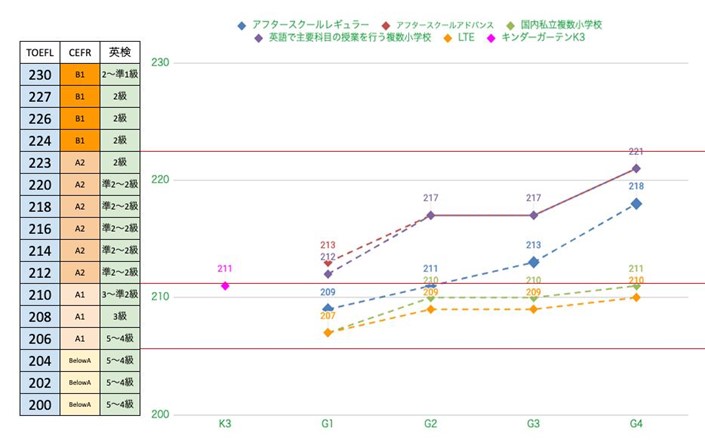
3-1.Kindergarten as the Starting Point (Pink Graph)
The Kindergarten course students are still very young, and many are not yet accustomed to sitting through a one-hour test. As such, their results vary widely.
Overall, girls tended to score higher than boys, reflecting general developmental differences at this age.
The average score was 211 points, which should be viewed not as an endpoint but as a starting point for the Advanced Course pathway that follows.
It’s worth noting that students in the Advanced Course later reached an average score of 218 points by Grade 4.
3-2.Remarkable Scores from the After School Course
The After School program is divided into two levels:
Advanced Course: for students already familiar with English, such as returnees or graduates of our Kindergarten
Regular Course: for students new to English
A: Regular Course (Blue)
As shown in the data, students’ English proficiency steadily improved over four years.
By Grade 4, they achieved an impressive average score of 218, equivalent to Eiken Pre-2 to 2 Level.
This score far exceeds the average of private elementary schools known for strong English programs (green line).
This demonstrates that even our Regular Course provides students with a much higher level of English proficiency than typical school-based English education.
B: Advanced Course (Red)
The Advanced Course also showed consistent improvement over four years.
Interestingly, their average scores nearly matched those of international schools, including IB schools, where English is the primary medium of instruction.
This means that our Advanced Course students have reached a level sufficient for academic learning conducted in English.
In particular, the average score of 221 in Grade 4 corresponds to Eiken Level 2 or CEFR B1, representing top-tier English ability for their age.
CEFR B1 Level Description:
Can describe experiences, events, dreams, hopes, and ambitions and briefly give reasons and explanations for opinions and plans.
Can understand the main points of clear, standard input on familiar matters regularly encountered in work, school, or leisure.
Can deal with most situations likely to arise while traveling in areas where the language is spoken.
Can produce simple connected text on familiar topics or those of personal interest.
3-3.Steady Growth in the LTE Course (Orange Graph)
The LTE Course provides an introductory level of English learning, with fewer weekly classes compared to the After School Course.
As expected, this course produced lower scores overall. However, students demonstrated consistent year-over-year improvement.
The results were roughly equivalent to the averages of private schools in Japan that place strong emphasis on English education, confirming that LTE students are steadily building English proficiency.
3-4.Reading Scores Increase Significantly in Grades 3 and 4
The TOEFL Primary® Test measures two key areas: Listening and Reading.
As in natural language acquisition, listening skills typically develop first, followed by reading and writing.
Our data confirmed this trend — younger students (Kindergarten, Grade 1) showed higher Listening scores.
From Grade 3 onward, Reading scores improved significantly, likely due to our program design:
All students begin Reading and Writing practice from Grade 1, and starting in Grade 3, we add a writing-focused curriculum.
This enhancement contributed to the sharp rise in Reading scores between Grades 3 and 4.
| After School Regular | After School Advanced | |||
| Listening | Reading | Listening | Reading | |
| Kindergarten | – | – | 107 | 104 |
| Grade 1 | 106 | 103 | 109 | 105 |
| Grade 4 | 109 | 109 | 111 | 110 |
3-5.Steady Growth through Our English Programs
We are pleased to confirm that our students’ English proficiency continues to grow steadily through Grade 4.
Looking ahead, we aim to further enhance the quality of our education by focusing on:
● Increasing the number of test participants to improve data accuracy
● Applying insights from test results to refine curriculum and instruction
● Sharing results with parents in a clearer and more accessible way
Thank you very much for your cooperation and continued support.
April 16, 2024
Ryo Tsuboya
COO, Tokyo International School Group
TOEFL Primary® measures English proficiency from below CEFR A1 up to B1.