
Hello Everyone,
On Sunday, June 18, 2023, we held Education Seminar Vol. 9:
“Thinking with Kindergarten Trainer Mr. Dan – How to Interact with Children So They Grow.”

For this seminar, our speaker was Tokyo International School Kindergarten Trainer
Daniel Stapleton (Mr. Dan).
Prior to the event, we asked parents to submit questions and concerns such as:
“Even though I’m trying and making an effort to keep daily life and learning smooth with my child,
things don’t go as planned and I’m not sure what to do.”
The seminar proceeded in a Q&A format responding to those submissions.
Drawing on his many years of knowledge and experience, our school’s educational philosophy,
and his own experiences as a parent, Mr. Dan addressed these questions.
In fact, during the ten days leading up to the seminar, we held three intensive prep meetings
to craft responses—discussing what would help parents enjoy parenting more and, in a positive way,
feel it is easier, and what they should know in order to firmly support their children’s growth.
In this blog post, we share your questions and Mr. Dan’s comments.
On the day of the seminar, our Kindergarten General Manager Ms. Aya also offered answers,
and we include her comments here as well.
Ms. Aya

You can view the archive of the seminar using the link below—please take a look.
We have published the seminar video on YouTube!
Whether or not you joined us live, please watch it for review or catch-up.
[Contents]
My child doesn’t want to go to nursery school. How can I help them look forward to what lies ahead?
My older son loves video games and is reluctant to go to cram school; I’m worried.
I get irritated when I have to repeat the same warnings and my tone becomes harsh.
Tips for responding to undesirable behavior.
My child wakes up early, so I’d like them to study in the morning, but they aren’t motivated.
Avoids trying new things; wants someone with them for everything. How can we build independence?
My child struggles with time awareness. When can kids develop the habit of checking the clock?
Mealtime drags on and the kids start playing; the older child lacks study time and the younger lacks sleep.
Summary of Key Messages from Mr. Dan
◎ Children have “reasonable expectations” appropriate to their age and individual developmental stage.
◎ Children live in the now. Their sense of time—especially of past and future—differs entirely from adults’.
◎ Adopt an Age & Stage perspective: focus on what children can do now, aligned with their age/development.
◎ Keep Executive Functions in mind: many things adults expect children to “be able to do” are skills they will acquire gradually as they develop.
◎ It takes time to learn time. Internalizing the concept of time takes… time.
◎ Be consistent. Patient, repeated, steady guidance. Mastery usually takes longer than adults expect.

1.My child doesn’t want to go to nursery school… How can I help them look forward to what’s next? (Parent of a pre–K3 child)
Mr. Dan
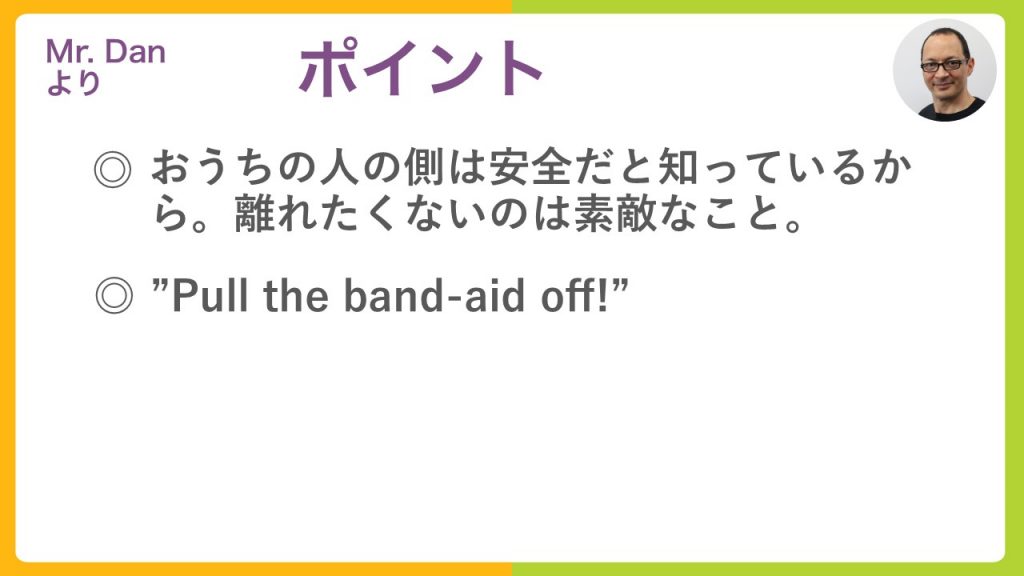
Your child likely feels safe near their caregivers. That’s a wonderful thing.
Here, the parent’s stance and behavior are key.
“Pull the band-aid off!”
Rather than peeling away slowly, step away decisively—like removing a bandage in one go.
Ms. Aya
Children live in the now.
Young children don’t have a grasp of time—especially not of past or future.
Telling them “Mom will come at ● o’clock. It’s okay,” often doesn’t land. Keep that in mind.
Usually, once the next activity begins, children forget they were crying.
It’s also important to create positive experiences—short stays or familiar settings—so they learn,
“Mom/Dad always comes back.”
Mr. Dan
At our kindergarten, we place visual magnets on a whiteboard for each daily activity—
morning meeting, circle time, lunch, inquiry time, park time, etc.—so children can see the sequence.
After each activity ends, we remove that magnet, and the very last one is “Pick-up / Go home.”
We’ll revisit time concepts again later in this post in response to another question.
2.My first-grader loves games and avoids cram school.
Mr. Dan
Distinguish between “a task a child could do but something is getting in the way” and
“a task they simply cannot yet do because it develops later”—the latter relates to executive function.
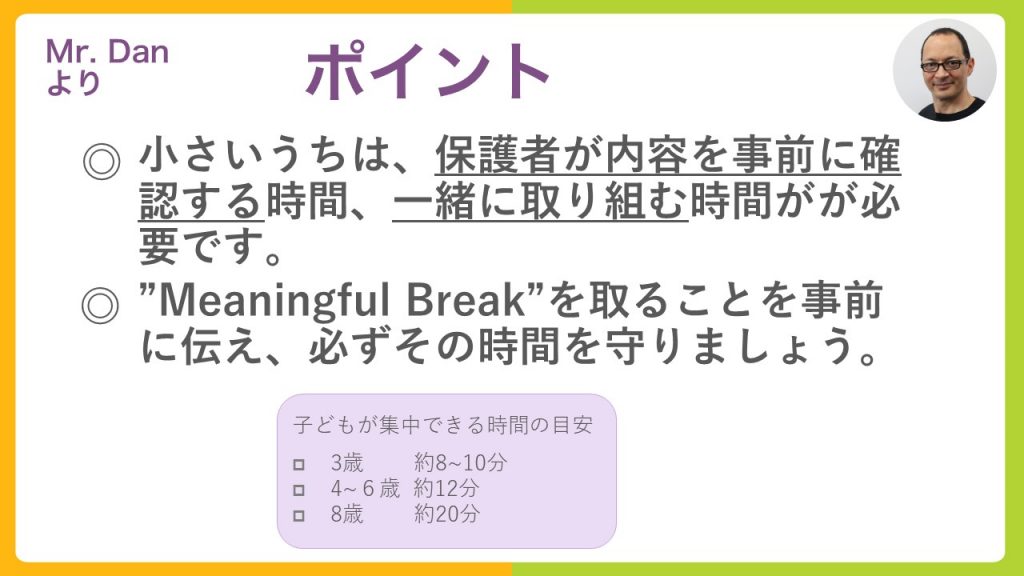
For young children, parents should preview homework/lesson content:
Is it too easy or too hard? Then sit with the child during the task.
Also note age-based limits to sustained attention and plan meaningful breaks.
Agree on breaks in advance—and honor the agreement.
Typical focus spans: about 8–10 minutes at age 3; ~12 minutes at ages 4–6; ~20 minutes at age 8.
A sip of water or a restroom trip isn’t a meaningful break; try ~3 minutes of light physical activity.
Ms. Aya
Parents tend to fixate on what children “can’t do,” but please don’t worry.
What they can do will increase with development.
For example, “stopping tears intentionally”: young children can’t yet regulate emotions and bodily reactions.
With growth, they learn how to calm themselves and judge—based on context and feelings—whether to do so.
Consistency matters.
Consider whether past instances unintentionally rewarded undesirable tactics
(e.g., long explanations, whining) by letting the child skip homework or cram school.
Parents need the resolve to keep their own approach steady.
3.I often find myself getting irritated and speaking harshly when I have to remind my child of the same thing over and over again.(Parents of a K4 child)/Even after telling my child the same thing many times (for example, about meals, bath time, or bedtime), they don’t listen. I sometimes end up raising my voice or yelling. I would appreciate any advice on how to handle this.(Parents of a Pre-K child)
Mr. Dan
Let’s review parent behavior from two angles.
First, what we call Age & Stage: aligning expectations with developmental capacity
(see also earlier notes on executive functions).
There are things we can reasonably expect now, and things we should not yet expect.
Pause and ask whether your requests align with your child’s current stage.
We covered this more academically in a previous seminar:
Education Seminar Vol. 4 “Let’s Increase What Children Can Do! – Developmental Stages and Social Skill Acquisition” by Saki Koh
Second, the concept of time.
We often see explanations like “You’ll be in trouble later,” “It will help you in the future,”
but children live in the now—future-oriented reasons don’t resonate.
Please focus on recognizing and praising what they can do right now.
Ms. Aya
Because children live in the now, their actions aren’t motivated by a chain from the past or toward the future.
They draw now because drawing is fun—simple as that.
At the same time, around age 3 is a prime period to build daily routines that become the backbone of life:
bath after videos, play after finishing worksheets, brush teeth and get dressed after playing, and so on.
Crucially, caregivers should do these together with young children,
and ideally keep routines consistent even on weekends.
Practical tips:
If you repeat the same words, children may tune them out.
If you say “I’ll tell you three times,” then after the third time, stop the reminders.
Also, always follow through on what you say:
“Shall we draw together after lunch?” “After three more turns, it’s bedtime.”
Doing these together smooths the process.
Avoid ad-hoc exceptions like “Not today because XX” or “Just one more because YY.”
Consistency is vital when building routines.

4.I would like to know some tips on how to respond effectively when my child shows undesirable behavior.(Parents of a K3 child)/My older child has recently turned five, and we find ourselves getting angry more often. In daily life, they sometimes say unkind things to get attention from others.(Parents of a K3 and a 5-year-old child)
Mr. Dan
Key ideas: Temper Tantrums and Rewards & Consequences.
Young children may have tantrums until a certain age—it’s part of development.
Know that some reactions are beyond their control.
At the same time, praise and discipline are important.
Use appropriate rewards and consequences proportional to the behavior—without overreacting—
and keep your responses consistent.
Ms. Aya
When a younger sibling arrives, it’s natural for parents to expect “big brother/sister” behavior.
But up to around age five, children still need caregiver support.
Be patient and provide that support even for the older child.
When anger arises, first acknowledge the feeling.
Then show a concrete next step:
“You’re angry about ●●. I understand. Let’s count to ten together—1, 2, 3… 10!”
Three-year-olds are egocentric; they don’t yet grasp “what not to do.”
At our kindergarten, we learn about Empathy throughout the K3 year.
>>Blog: “Kindergarten Teachers’ Passion – Vol. 1” (Nakameguro – Ms. Kaitlyn) <<
If a child uses unkind words to seek attention, don’t reinforce it by reacting.
They may be repeating a behavior that previously got them attention.
Instead, withhold attention for the negative tactic and teach the right way to seek attention:
“No one will want to play when you do that—it feels sad, right?
When you want attention, try saying ●●.”
Then, when they use the right approach, respond clearly and praise it.

5.My child wakes up early, so I would like to have them do some kind of learning activity in the morning, but it’s difficult to motivate them.(Parents of a K3 and a 5-year-old child)
Mr. Dan
“Work / Life Balance” applies to children, too.
Consider why your child woke early, and help them balance “work” (study, routines) with enjoyable activities.
As in the fable The Ant and the Grasshopper: work first, then fun.
Ms. Aya
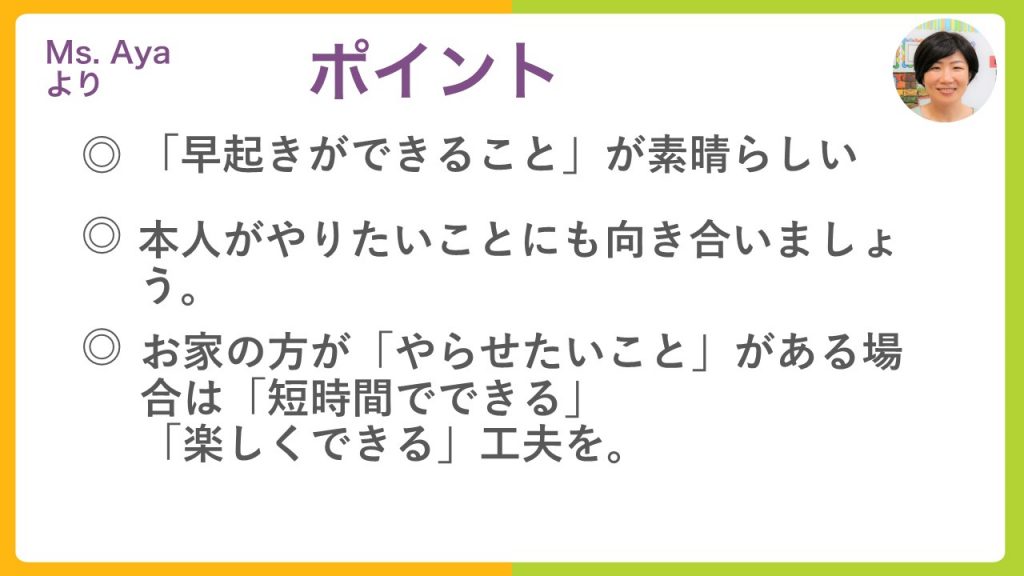
Waking up early is great in itself!
If mornings are forced study time, children may link “waking early” with “being made to do unpleasant things”
and stop wanting to get up.
Balance what parents hope for with what the child wants to do.
Keep it short and make it enjoyable so it becomes sustainable.
6. My child is not good at trying new things. They need to observe others and see that the other children can do it before they feel confident enough to try, especially for physical activities. They want someone to do everything together with them. What can I do to help foster their independence?(Parent of a K3 child)
Mr. Dan
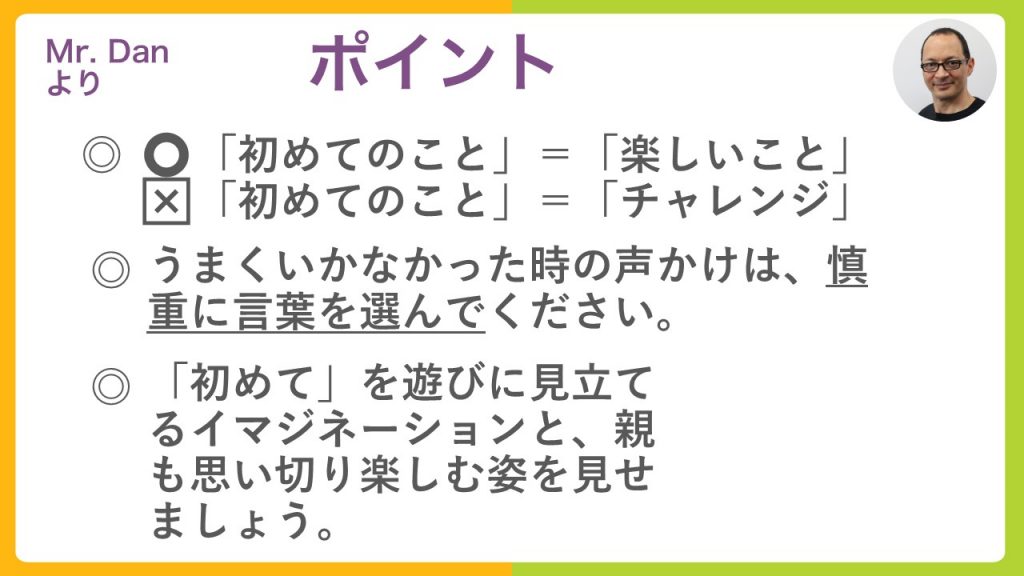
Children don’t need “challenges” per se.
If “new” equals “fun,” they’ll dive in—so shape the environment to make it feel that way.
If “new” feels like a challenge, caution is natural.
They may also fear failure—choose words carefully when things don’t go well.
Encourage the mindset: “It’s okay to fail; let’s try again.”
Turn “firsts” into play and model joyful participation as a parent.
Don’t “practice tennis”; defeat the aliens! Not “let’s run drills,” but “let’s play tag!”
Skip “catch practice”—try dodgeball-style rules.
Let children invent rules—their imagination is limitless.
Ms. Aya
Being observant from a young age is a strength.
Your child understands themselves and steps forward when it feels safe.
Judging one’s timing is as valuable as fearlessly jumping in.
If you consistently praise the attempt (not only the outcome), confidence will grow and hesitation will shrink.
Pushing them away can leave only a bad memory.
Accompany them as much as possible—
you may find independence comes sooner when they can eventually say, “I’m okay. I’ll do it by myself.”
Remember: praise the attempt, not just success.
7.My child has difficulty being aware of time. At what age can I expect them to develop the habit of checking the clock?(Parent of a Pre-K child)/Even when my child sits at their desk, they tend to be sluggish and have difficulty concentrating. I correct their posture and handwriting because it becomes sloppy, but it’s hard to get them to improve.(Parent of a child in Grade 3 or above)
We received more questions on time management than any other topic.
Mr. Dan
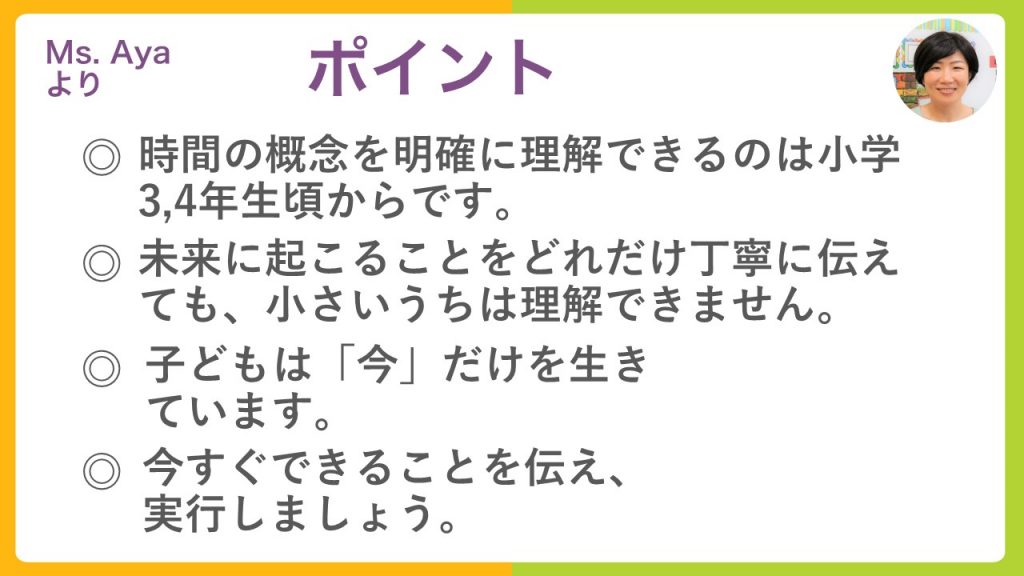
First, understand that young children do not have a concept of time.
They learn to read clocks around K3–Grade 1, but managing behavior by the clock usually appears around Grades 3–4.
Ms. Aya
Exactly—true understanding of time comes around Grades 3–4.
Until then, future-oriented explanations won’t make sense.
Because children live in the now, they also forget the past quickly.
Tell them what they can do now and what will happen right after.
Say, “Let’s practice then read a picture book,” or, “After ▲▲ we’ll do ●●,”
linking now to the immediate next step.
“Do homework at ■ o’clock,” “Only five minutes left,” “We’re going out this afternoon, so practice now”—
these won’t land, because children can’t gauge how far away ■ o’clock is or how long “five minutes” or “this afternoon” is.
Similarly, at drop-off, “I’ll be back soon” is hard to grasp—hence prolonged crying.
At our kindergarten, we sometimes place a big arrow on the classroom clock and say,
“When the long hand reaches the arrow, we’ll do ●●.”
We also display colorful sequence cards to “make visible” what’s done, what’s happening now, and what’s next.
8.It’s great that my children get along well, but their mealtimes often run long or they end up playing together. As a result, my older child doesn’t get enough study time, and my younger child doesn’t get enough sleep, which is a concern.(Parent of a Grade 2 child and a younger sibling)
Ms. Aya
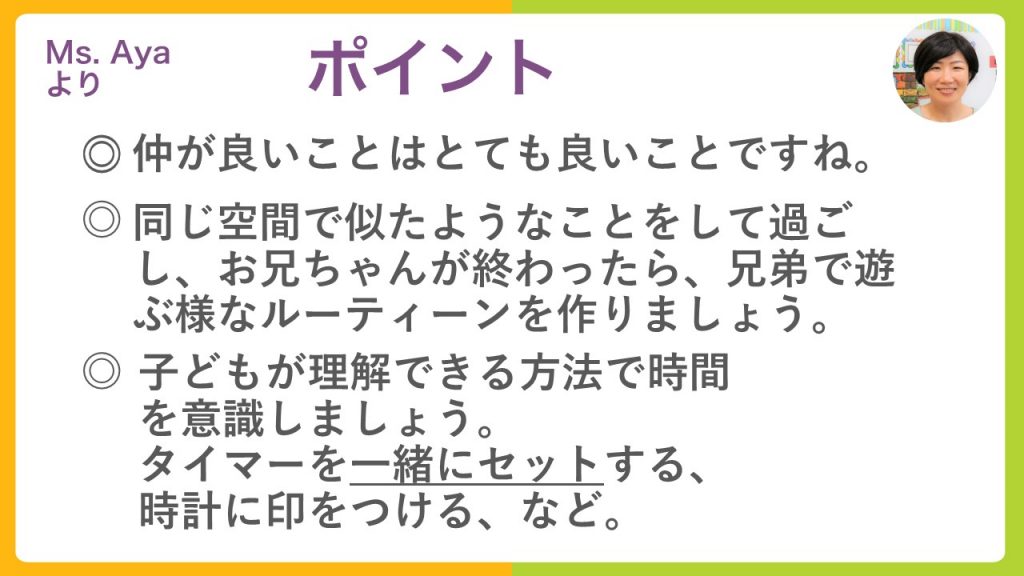
It’s wonderful that they get along.
If the younger child can participate, try spending time in the same space doing similar activities,
then play together once the older sibling is finished.
For example, hold a pencil or crayon and work on a simple worksheet, or draw silently.
If the younger child finishes first and gets bored, they may gradually learn that the older sibling needs more time.
When setting a study window like “until ●● o’clock,” use a child-friendly approach:
set a timer together—the key is that children help set it, which builds ownership.
――――――――――――――――――――
We have published the seminar archive on YouTube!
Whether you missed the event or would like to review it, please watch the full recording.
>> Seminar Video (Approx. 58 minutes) <<
Our next Education Seminar—featuring a new speaker and theme—is planned for September 2023.
We will announce the topic and registration on this blog and via Twitter.
Please look forward to it!